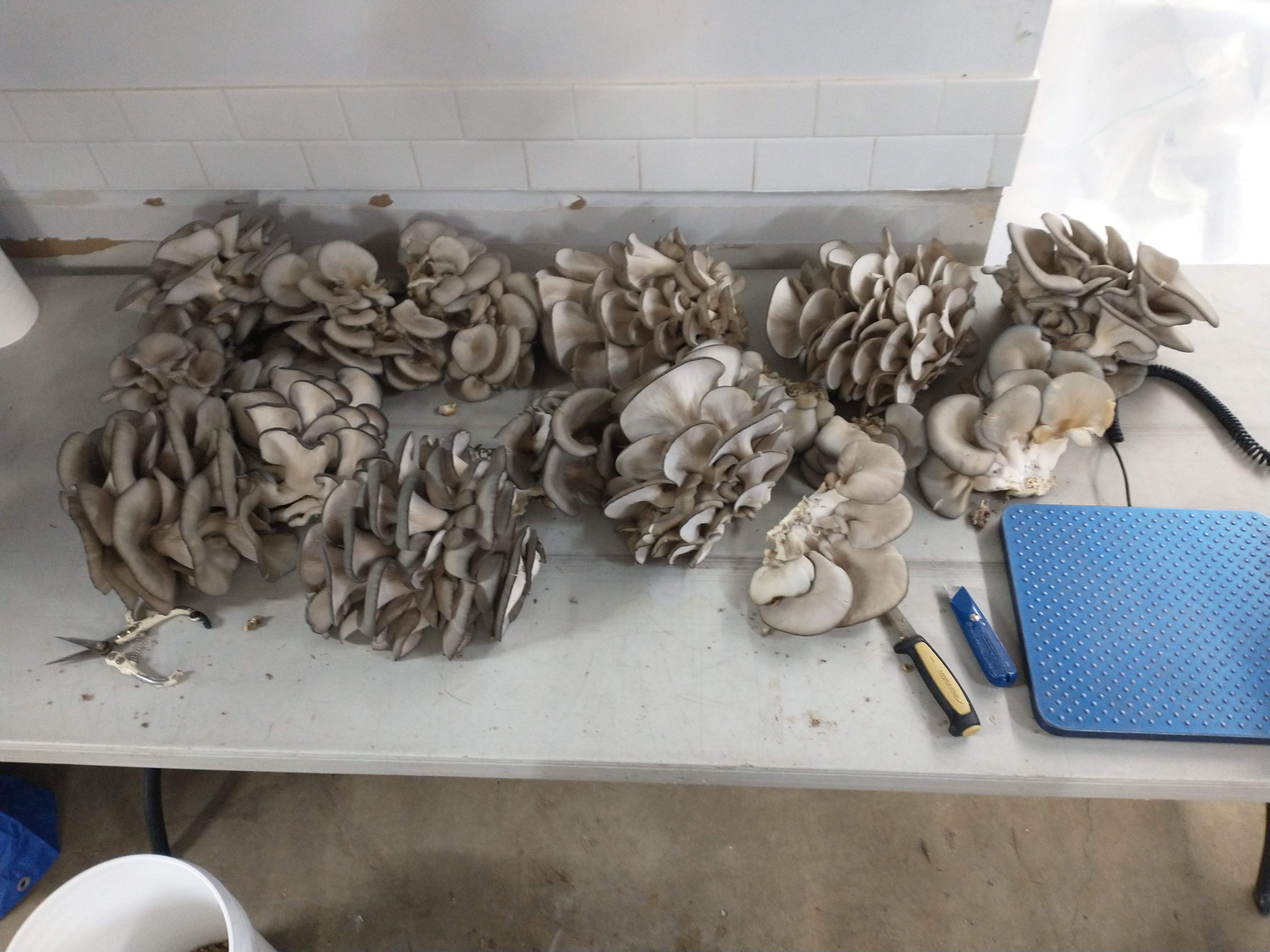
Blue oyster
Pleurotus ostreatus
Harvest Details
Blue Oyster Mushroom (Pleurotus ostreatus) is a wood-decaying mushroom associated primarily with dead, dying, or weakened hardwood trees.
In the wild, oyster mushrooms commonly fruit from logs, fallen trunks, stumps, standing deadwood, and other woody material. Hardwood hosts can include cottonwood, aspen, willow, maple, beech, poplar, and related deciduous species, depending on geographic region.
The fungus is saprotrophic and plays an important ecological role by breaking down lignin and cellulose in wood and returning nutrients to forest ecosystems.
Blue Oyster mushrooms are also widely cultivated. Commercial growers can produce them on sterilized or pasteurized lignocellulosic materials such as hardwood sawdust, straw, agricultural byproducts, and supplemented hardwood substrates.
Cultivated Blue Oysters commonly form dense clusters of overlapping, shelf-like caps. Their blue coloration is generally strongest when mushrooms are young and can fade toward blue-gray or gray as the fruiting bodies mature.
Habitat and appearance can vary with strain, temperature, humidity, substrate, elevation, and local environmental conditions.
Wild Blue Oyster and other Pleurotus ostreatus fruitings are strongly influenced by temperature, moisture, host wood, and local climate.
In many temperate regions, oyster mushrooms are most strongly associated with cool, moist weather and may fruit from autumn into winter. Fruiting can also occur during other seasons when temperature and moisture conditions are favorable.
In the Pacific Northwest, local timing varies considerably by elevation and microclimate. USDA Forest Service observations from the Blue Mountains report oyster mushroom fruiting during both summer and fall.
Rainfall, sustained humidity, cool temperatures, and moisture retained within host wood can trigger fruiting. A productive log or tree may produce additional flushes when favorable conditions return.
Cultivated Blue Oyster mushrooms are not restricted to a natural season. Growers can produce them throughout the year by controlling temperature, humidity, fresh-air exchange, lighting, and substrate moisture.
Pleurotus ostreatus occurs across temperate regions and is also extensively cultivated around the world.
Within the Pacific Northwest, oyster mushrooms can occur in suitable hardwood habitats in Washington, Oregon, Idaho, and surrounding areas. Distribution is highly localized because fruiting depends on the presence of suitable host wood, moisture, temperature, and other environmental conditions.
In the Inland Northwest and Blue Mountains, productive habitat may be concentrated around riparian corridors and other areas supporting hardwoods such as cottonwood and aspen.
Wild occurrence should always be evaluated at the local habitat level rather than assuming that the mushroom will be equally abundant throughout an entire state or region.
Cultivated Blue Oyster mushrooms have a much broader commercial distribution because indoor and controlled-environment production allows growers to reproduce suitable fruiting conditions throughout the year.
Scientific Group: Pleurotus spp. Blue Oyster strains are commonly associated with Pleurotus ostreatus and closely related cultivated oyster strains.
Growth Pattern: Usually forms overlapping, shelf-like clusters growing directly from wood or a wood-based substrate.
Cap: Fan-, shell- or oyster-shaped. Young Blue Oyster caps may display striking blue, steel-blue or blue-gray coloration before becoming gray, gray-brown or paler with maturity.
Gills: Closely spaced and typically white to cream. The gills are decurrent, meaning they extend downward along the stem or attachment point.
Stem: Often short, lateral or nearly absent, particularly when fruiting from the side of a log. Cluster position and environmental conditions can substantially affect stem length.
Flesh: White to off-white, firm when young and increasingly tough with age.
Spore Print: Typically white to pale lilac-gray/lilac depending on the Pleurotus species and conditions.
Odor: Generally mild and pleasant, sometimes described as subtly mushroom-like or faintly anise-like.
Substrate: Associated primarily with dead, dying or weakened wood, particularly hardwoods. Cultivated Blue Oysters can be produced on several prepared lignocellulosic substrates.
Key Identification Combination: Look for clustered shelf-like growth from wood + oyster-shaped caps + pale decurrent gills + pale spore print.
Look-Alike Warning: Several wood-growing mushrooms can superficially resemble oysters. Blue coloration by itself does not confirm identity. Identification should consider substrate, gills, attachment, cap structure, spore print and other characteristics together.
Food Safety: Only consume mushrooms whose identity has been confidently established. Wild mushrooms should never be considered edible solely because they resemble a photograph or encyclopedia entry.
Foraging Tips
Blue Oyster mushrooms sold commercially are commonly cultivated strains of oyster mushroom. Wild oyster mushrooms in the Pleurotus group may resemble cultivated Blue Oysters, so identification should be based on multiple characteristics rather than color alone.
Where to Look: Search dead or dying hardwood trees, fallen logs, stumps and large woody debris. Oyster mushrooms typically grow directly from wood rather than from ordinary forest soil.
Timing: Look after periods of rainfall or sustained humidity when temperatures are favorable. Productive wood can sometimes fruit repeatedly when environmental conditions return.
Check the Entire Tree: Examine the trunk, stump, fallen sections and underside of logs. Clusters can occur above eye level or on less-visible sides of woody material.
Return to Productive Locations: Oyster-producing logs and trees can potentially fruit again as long as suitable substrate remains.
Harvest Quality: Favor young, firm specimens with intact caps. Older specimens can become tough, damaged or heavily inhabited by insects.
Harvest Carefully: Cut or twist clusters away without unnecessarily tearing apart the underlying wood. Leave very small or immature clusters to continue developing when appropriate.
Important: Never identify an edible mushroom from color, season or a photograph alone. Confirm all important identification characteristics before consumption. When uncertain, consult an experienced local identifier or mycological organization.
Preservation & Storage
Fresh Storage
Refrigerate fresh Blue Oyster mushrooms promptly.
Store them in packaging that allows appropriate airflow rather than trapping excessive condensation against the mushrooms.
Handle gently because the caps can bruise and crack.
For best culinary quality, use while the mushrooms remain firm, fresh-smelling and free from deterioration.
Do not wash before storage. Clean shortly before cooking.
Refrigeration
Keep refrigerated under proper food-storage conditions. Actual shelf life varies depending on harvest maturity, handling, packaging, temperature and initial quality.
Inspect before use and discard mushrooms showing clear spoilage, objectionable odor or significant deterioration.
Drying
Blue Oyster mushrooms can be dehydrated for longer storage.
Clean and separate or slice the mushrooms into reasonably uniform pieces.
Dry using a food dehydrator according to the manufacturer's recommendations until thoroughly dried.
Allow them to cool completely before transferring to an airtight container.
Store dried mushrooms in a cool, dry and dark location.
Rehydrate in warm water, broth or another cooking liquid before use. The soaking liquid can contribute mushroom flavor to soups and sauces when appropriate.
Freezing
For better texture, cook Blue Oyster mushrooms before freezing rather than freezing fresh mushrooms whole.
Sauté until much of their moisture has been released. Cool rapidly, portion into freezer-safe containers and freeze.
Frozen cooked mushrooms work particularly well in soups, sauces, pasta and other cooked preparations.
Preservation Tip
For the highest-quality fresh product, good temperature management and careful handling from harvest through sale are more important than attempting to extend storage after quality has already declined.
Microclimates
Blue Oyster mushrooms respond strongly to changes in temperature, humidity, airflow, rainfall and available moisture.
Temperature: Cooler conditions generally encourage the characteristic blue to blue-gray coloration of young caps. As temperatures rise or mushrooms mature, caps commonly fade toward gray, gray-brown or tan. Color intensity varies by strain and growing conditions.
Humidity: High relative humidity supports healthy fruit-body development. Dry conditions can cause caps to dry, crack, curl or stop developing. Excessively wet conditions combined with poor airflow can contribute to overly wet fruit bodies and increased microbial problems.
Rain & Moisture: In outdoor environments, periods of rain and sustained moisture can stimulate fruiting when temperatures and substrate conditions are favorable. Extended dry periods can delay or stop fruiting.
Airflow & CO₂: Fresh-air exchange strongly affects development. Elevated carbon dioxide can encourage elongated stems and smaller or poorly developed caps. Adequate airflow generally produces broader, better-developed caps.
Light: Blue Oysters do not photosynthesize, but light provides an important developmental signal and can influence normal cap formation and orientation.
Wind: Strong or persistent dry wind can rapidly remove moisture from exposed fruit bodies, particularly around cap margins.
Local Variation: Two nearby locations can produce noticeably different mushrooms because shaded depressions, creek bottoms, north-facing areas, logs, stumps and protected forest pockets may retain moisture and remain cooler than exposed surroundings.
Nutritional Metrics
Medicinal Value
Blue Oyster mushrooms contain several compounds being investigated for potential health-related properties, including beta-glucans, dietary fiber, polyphenols, ergothioneine, and other bioactive compounds.
Beta-glucans from fungi have received particular research attention for their interactions with immune function and the gut microbiome.
Human clinical studies of Pleurotus ostreatus have also investigated possible effects on glucose metabolism, blood lipids, and blood pressure. Some trials have reported favorable changes, but systematic reviews have found that the available evidence remains limited by small study sizes and methodological weaknesses.
Blue Oyster mushrooms should therefore be regarded primarily as a nutritious edible food rather than as a treatment or cure for disease.
Research areas:
• Beta-glucans and immune function
• Dietary fiber and digestive health
• Glucose metabolism
• Lipid metabolism
• Antioxidant compounds
• Gut microbiome interactions
Evidence status: Promising areas of research, but additional high-quality human clinical trials are needed.
Recipes & Pairings
Flavor & Cooking Profile
Blue Oyster mushrooms have a mild, savory, slightly earthy flavor and a tender, meaty texture. When cooked over medium-high or high heat, their edges become beautifully golden and crisp while the thicker portions remain tender.
They are an excellent everyday mushroom for people who are new to specialty mushrooms because they work well in familiar dishes and don't require complicated preparation.
Great Home Pairings
Fats: Butter, olive oil, avocado oil
Herbs & Seasonings: Garlic, onion, thyme, rosemary, parsley, chives, black pepper, smoked paprika
Cheese & Dairy: Parmesan, mozzarella, cheddar, goat cheese, cream
Vegetables: Potatoes, onions, spinach, peppers, tomatoes, broccoli, asparagus
Other Pairings: Eggs, pasta, rice, tortillas, bread, chicken, steak, soy sauce, ginger, sesame, lemon and lime
Before Cooking
Trim off the tough base where the mushroom cluster was attached to the growing substrate.
Separate the mushrooms by hand or tear larger caps into pieces.
If cleaning is necessary, gently brush away debris or wipe the mushrooms with a slightly damp towel. Avoid soaking them in water.
For the best browning, give the mushrooms plenty of room in the pan.
RECIPE 1 — GARLIC-BUTTER BLUE OYSTERS
Serves: 2–3
Prep Time: 5 minutes
Cook Time: 8–10 minutes
Ingredients
8 oz Blue Oyster mushrooms
2 tbsp butter
2 cloves garlic, minced
1/4 tsp salt, or to taste
Freshly ground black pepper
1 tsp fresh lemon juice
1 tbsp chopped fresh parsley, optional
Instructions
1. Prepare the mushrooms.
Trim away the tough bottom of the cluster. Separate the mushrooms and tear very large pieces in half.
2. Heat the pan.
Place a large skillet over medium-high heat.
3. Brown the mushrooms.
Add the mushrooms in a single loose layer. Cook for about 2–3 minutes without moving them very much.
Turn the mushrooms and continue cooking until they begin turning golden.
4. Add the butter and garlic.
Add the butter. Once melted, add the minced garlic.
Cook for another 2–3 minutes, stirring occasionally, until the mushrooms are golden and the edges are slightly crispy.
5. Season.
Add salt and freshly ground black pepper.
Finish with lemon juice and parsley if desired.
Serving Ideas
Serve alongside eggs, steak, chicken or potatoes, spoon over toasted bread, or add to pasta, rice or vegetables.
Home Cook Tip: Don't crowd the skillet. If you're making a large batch, cook the mushrooms in two batches so they brown instead of steam.
RECIPE 2 — CRISPY BLUE OYSTER TACOS
Serves: 3–4
Prep Time: 10 minutes
Cook Time: 10–12 minutes
Ingredients
For the Mushrooms
12 oz Blue Oyster mushrooms
2 tbsp olive or avocado oil
1/2 tsp smoked paprika
1/2 tsp garlic powder
1/2 tsp ground cumin
1/4 tsp salt
Freshly ground black pepper
For the Tacos
8 small corn or flour tortillas
1 cup finely shredded cabbage
1 avocado, sliced
1/2 cup salsa
1 lime, cut into wedges
Chopped cilantro, optional
Sour cream or Mexican-style crema, optional
Instructions
1. Prepare the mushrooms.
Trim the tough base from the cluster.
Use your hands to tear the mushrooms lengthwise into bite-sized strips.
2. Season.
Place the mushrooms in a bowl.
Add oil, smoked paprika, garlic powder, cumin, salt and black pepper. Toss gently until evenly coated.
3. Heat the skillet.
Heat a large skillet over medium-high to high heat.
4. Cook until crispy.
Spread the mushrooms across the hot skillet without overcrowding.
Cook for approximately 3–4 minutes before turning.
Continue cooking another 3–5 minutes until the mushrooms are browned with crispy edges.
5. Warm the tortillas.
Warm the tortillas in a dry skillet, microwave or directly over a gas flame using appropriate care.
6. Assemble the tacos.
Place crispy Blue Oyster mushrooms into each tortilla.
Top with shredded cabbage, avocado and salsa.
Add cilantro and crema if desired.
7. Finish.
Squeeze fresh lime over each taco immediately before serving.
Easy Variation
For spicy tacos, add cayenne, chipotle powder or your favorite hot sauce.
For extra crunch, add sliced radish or pickled onions.
RECIPE 3 — BLUE OYSTER PARMESAN PASTA
Serves: 3–4
Prep Time: 10 minutes
Cook Time: 15–20 minutes
Ingredients
12 oz Blue Oyster mushrooms
8 oz spaghetti, linguine or fettuccine
2 tbsp butter
1 tbsp olive oil
3 cloves garlic, minced
1/2 cup freshly grated Parmesan cheese
1/2–1 cup reserved pasta water
1/2 tsp salt, or to taste
Freshly ground black pepper
1 tbsp chopped fresh parsley
1–2 tsp fresh lemon juice, optional
Extra Parmesan for serving
Instructions
1. Prepare the mushrooms.
Trim away the tough base and separate the mushrooms.
Tear larger mushrooms into bite-sized pieces.
2. Cook the pasta.
Bring a large pot of salted water to a boil.
Cook the pasta according to the package directions until al dente.
Before draining, reserve about 1 cup of the pasta water.
Drain the pasta.
3. Brown the mushrooms.
While the pasta cooks, heat olive oil and 1 tablespoon butter in a large skillet over medium-high heat.
Add the mushrooms in a loose layer.
Allow them to cook undisturbed for approximately 2–3 minutes before stirring.
Continue cooking until golden brown.
4. Add the garlic.
Reduce the heat to medium.
Add the remaining tablespoon of butter and minced garlic.
Cook for about 30–60 seconds, just until the garlic becomes fragrant.
5. Add the pasta.
Add the cooked pasta directly to the skillet.
Pour in approximately 1/2 cup reserved pasta water and toss everything together.
6. Add Parmesan.
Reduce the heat to low.
Gradually add the Parmesan while continuously tossing the pasta.
Add additional pasta water a little at a time until the cheese and cooking liquid form a smooth, light sauce that coats the pasta.
7. Finish and serve.
Season with salt and plenty of freshly ground black pepper.
Add parsley and a small squeeze of lemon if desired.
Serve immediately with additional Parmesan.
More Easy Ways to Use Blue Oysters
Blue Oyster mushrooms are also excellent in scrambled eggs, omelets, pizza, ramen, stir-fries, soups, grilled sandwiches, rice bowls, mashed potatoes and roasted vegetable dishes.
Storage & Cooking Tip
Keep fresh Blue Oyster mushrooms refrigerated and use them while they are firm and fresh. Their delicate caps can bruise, so handle them gently.
When cooking, one of the easiest ways to improve the final dish is simply to avoid overcrowding the pan. High enough heat and adequate space allow moisture to escape and help create the golden, crispy edges that make Blue Oyster mushrooms especially enjoyable.
Additional Context
Oyster mushrooms have a long history as edible wood-growing mushrooms and today are among the most widely cultivated specialty mushrooms in the world.
Commercial cultivation of oyster mushrooms expanded substantially during the 20th century because Pleurotus species grow efficiently on many lignocellulosic agricultural materials, including straw and other plant-based substrates.
Blue Oyster is a cultivated form or strain within the oyster mushroom group, valued particularly for the blue-gray coloration of young caps, vigorous growth, attractive clusters and culinary versatility.
Oyster mushrooms have become important in cuisines around the world because their mild savory flavor readily accepts other ingredients and their substantial texture works well in soups, stir-fries, noodle dishes, sauces, grilled preparations and meatless entrées.
Modern mushroom cultivation has also made Pleurotus species important subjects of research involving agricultural-waste utilization, fungal biotechnology, nutrition and mycoremediation.
Culinary Tradition: Oyster mushrooms are especially compatible with Asian and European cooking traditions but have become broadly used in contemporary American cuisine, particularly in plant-forward and farm-to-table cooking.
Blue Oyster mushrooms demonstrate one of the particularly interesting characteristics of fungi: their ability to grow on lignocellulosic plant material.
Cultivation Sustainability: Oyster mushrooms can be cultivated on agricultural and forestry-derived materials such as straw, sawdust and other suitable plant-based substrates. This provides opportunities to convert certain low-value plant materials into food.
Spent mushroom substrate may also have potential secondary uses depending on how it was produced and local requirements.
Ecological Role: Wild Pleurotus species are wood decomposers. Their mycelium breaks down components of dead or weakened wood and contributes to nutrient cycling in forest ecosystems.
Responsible Wild Harvest: Take only mushrooms that can be used or sold and avoid unnecessary disturbance to the surrounding habitat.
Leave very young mushrooms when practical so they can continue developing.
Avoid unnecessarily damaging logs, bark or woody substrate while removing clusters.
Do not harvest from protected areas or private property without authorization, and always follow applicable land-management rules, permits and harvest limits.
Low-Impact Principle: Harvest the fruiting body while minimizing disturbance to the underlying wood and surrounding habitat.
Commercial Consideration: Cultivation provides a dependable way to produce Blue Oyster mushrooms without relying on wild populations and allows growers to control substrate, harvest timing and production conditions.
• Blue Oyster is a blue-to-gray form of the oyster mushroom, Pleurotus ostreatus.
• Young fruiting bodies can display striking blue coloration that commonly fades toward blue-gray or gray as the mushroom matures.
• Oyster mushrooms typically grow in overlapping shelf-like clusters.
• They are wood-decomposing fungi capable of breaking down lignin and cellulose.
• Blue Oysters are popular cultivated mushrooms because they colonize suitable substrates rapidly and can produce substantial clustered fruitings.
• Commercial cultivation can use hardwood sawdust, straw, and other lignocellulosic agricultural materials.
• Their texture is tender but meaty, making them useful as both a vegetable and meat substitute in many dishes.
• The caps are generally the most tender portion, while larger stems can become tougher.
• Oyster mushrooms contain dietary fiber and fungal beta-glucans.
• Environmental conditions can significantly influence color, shape, size, texture, and nutritional composition.
Blue Oyster mushrooms are vigorous Pleurotus cultivars valued by commercial growers for aggressive colonization, attractive clustered fruiting, good yields and their distinctive blue-gray coloration. Exact requirements vary by strain, so the culture or spawn supplier's specifications should take priority when available.
Substrate
Blue Oysters can be commercially cultivated on properly prepared lignocellulosic substrates including:
Hardwood sawdust-based blocks
Supplemented hardwood sawdust
Pasteurized straw
Hardwood fuel pellets formulated into growing substrate
Other suitable agricultural plant residues
Commercial operations should use clean, properly prepared substrate and appropriate pasteurization or sterilization methods for the chosen production system.
Incubation / Colonization
Maintain stable conditions appropriate to the specific strain while the mycelium colonizes the substrate.
Blue Oyster mycelium is typically vigorous and can rapidly colonize suitable substrate. Maintain good sanitation and inspect blocks or bags for abnormal colors, odors or other signs of contamination.
Do not fruit visibly contaminated substrate in the production area.
Fruiting Temperature
Blue Oyster is generally considered a cool-weather oyster, although commercial strains vary considerably.
Many Blue Oyster strains perform well at approximately 50–65°F (10–18°C) during fruiting.
Cooler fruiting conditions generally encourage stronger blue coloration. Warmer conditions can produce lighter gray caps and may alter mushroom morphology.
Relative Humidity
During pinning and early fruit development, approximately 85–95% relative humidity is commonly used.
As mushrooms mature, sufficient humidity should be maintained to prevent drying while avoiding persistent free water on fruit bodies.
Balance humidity with adequate fresh-air exchange.
Fresh-Air Exchange / CO₂
Blue Oysters require substantial fresh-air exchange for desirable commercial morphology.
Excessive CO₂ commonly produces:
Long stems • Small caps • Reduced cap expansion • Less desirable cluster structure
Adequate fresh-air exchange encourages broader caps and shorter stems.
Growers should measure actual room CO₂ rather than relying exclusively on ventilation schedules because crop load can rapidly change room conditions.
Light
Blue Oysters benefit from regular diffuse light during fruiting.
Light acts primarily as a developmental and directional signal rather than an energy source.
Avoid excessive heat from lighting equipment.
Pinning
Initiate fruiting according to the requirements of the particular strain and production system.
Maintain high humidity, appropriate temperature, adequate fresh air and diffuse light.
Small pins should develop into dense clusters when environmental conditions remain balanced.
Harvest Timing
Harvest while clusters are firm and attractive and generally before caps become excessively flattened or upturned.
For premium fresh-market sales, harvesting somewhat younger clusters can improve appearance, durability and handling characteristics.
Cut the entire cluster cleanly from the block and trim away remaining substrate.
Multiple Flushes
Healthy substrate blocks can potentially produce additional flushes after the first harvest.
Allow an appropriate recovery period and maintain suitable conditions according to the production system.
Later flushes may differ in yield, cluster size and morphology.
Commercial Quality Indicators
Premium Blue Oyster clusters should generally have:
Firm caps • Attractive blue-gray to gray coloration • Clean appearance • Short, substantial stems • Well-developed caps • Minimal bruising • No obvious deterioration
Color varies substantially with strain, temperature, maturity and other environmental conditions and should not be used alone to judge quality.
Common Growing Problems
Long stems / Small caps: Often associated with excessive CO₂ or insufficient fresh-air exchange.
Dry or cracked caps: May indicate insufficient humidity, excessive airflow directly across the mushrooms or excessively dry conditions.
Wet or deteriorating caps: Can result from excessive surface moisture, poor air movement or delayed harvest.
Weak blue coloration: Can be influenced by genetics, maturity and warmer fruiting conditions.
Poor pin development: Review substrate condition, temperature, humidity, fresh-air exchange and strain-specific fruiting requirements.
Post-Harvest Handling
Cool harvested mushrooms promptly and minimize unnecessary handling.
Blue Oyster caps can be delicate and may crack or bruise during packing and transportation.
Trim substrate residue before packing and use packaging that protects clusters without excessive compression or condensation.
Maintain appropriate refrigerated conditions throughout storage and distribution.
Commercial Grower Tip
For consistent production, record each crop. Track strain, substrate formulation, inoculation date, colonization time, fruiting date, temperature, humidity, CO₂, harvest date, first-flush weight, subsequent-flush weights and rejected product.
Over multiple crops, these records can reveal which environmental settings and substrate formulations produce the best yield, morphology, quality and shelf performance for that particular Blue Oyster strain and facility.
Why Chefs Choose Blue Oyster
Blue Oyster offers chefs an unusual combination of dramatic appearance, approachable flavor and culinary versatility.
Young clusters can display striking blue-gray caps arranged in overlapping layers, creating a product that can become part of the visual architecture of a finished plate.
The mushroom responds particularly well to high-heat cooking. Depending on technique, a chef can create crisp edges, deep caramelization or a tender, substantial center.
Techniques Worth Exploring
Whole-Cluster Pressing: Compress an intact cluster against cast iron while searing to create a dramatic center-of-plate preparation.
Hard Searing: Develop a dark exterior before finishing with butter, herbs and aromatics.
Smoking: Introduce controlled smoke before or after searing for deeper savory character.
Frying: Preserve the irregular cap structure to create exceptionally crisp edges and dramatic shapes.
Glazing: Miso, black garlic, fermented chile, soy and reduced mushroom stocks complement the mushroom's savory character.
Texture Contrast: Combine crisp caps with purées, cultured sauces, pickled ingredients or toasted nuts. Chef Challenge
Don't automatically treat Blue Oyster as a replacement for meat.
Build a dish around what makes the mushroom itself unusual—its layered architecture, gills, ability to caramelize, irregular edges and transition between crisp and succulent textures.
Featured Concept: Pressed Blue Oyster Steak with Black Garlic–Miso Jus, smoked celery-root purée, pickled mustard seed and crispy mushroom trim.
Important: “Blue Oyster” most commonly refers to cultivated Blue Oyster strains. A wild mushroom displaying blue-gray coloration should not be assumed to be a cultivated Blue Oyster.
When searching for wild oyster-type mushrooms, concentrate on dead, dying and fallen wood rather than searching open soil Field Indicators
Look for overlapping shelf-like clusters attached directly to wood.
Examine the underside for pale, closely spaced gills that descend toward or along the attachment point.
Note the host wood, surrounding habitat, cap characteristics, gill attachment, stem structure and overall growth pattern.
A pale spore print can provide another identification characteristic.
Productive Habitat
After finding oyster mushrooms on a particular piece of wood, record the location and environmental conditions. Suitable woody substrate can potentially produce additional flushes when moisture and temperature again become favorable.
Check productive locations following significant moisture events.
Quality Selection
Young, firm mushrooms generally provide better culinary quality than old specimens.
Avoid heavily deteriorated, waterlogged or insect-damaged mushrooms intended for food.
Keep harvested mushrooms protected from heat and crushing.
Identification Warning
Never identify an edible oyster mushroom from blue-gray color alone.
Several wood-growing fungi can resemble oyster mushrooms to an inexperienced collector. Identification should consider multiple independent characteristics, including growth substrate, cap, gills, attachment, flesh and spore print.
If identification is uncertain, do not consume or sell the mushroom. Seek confirmation from a qualified local expert..
Ready to source Blue oyster?
Browse active lots from verified foragers in the marketplace.
