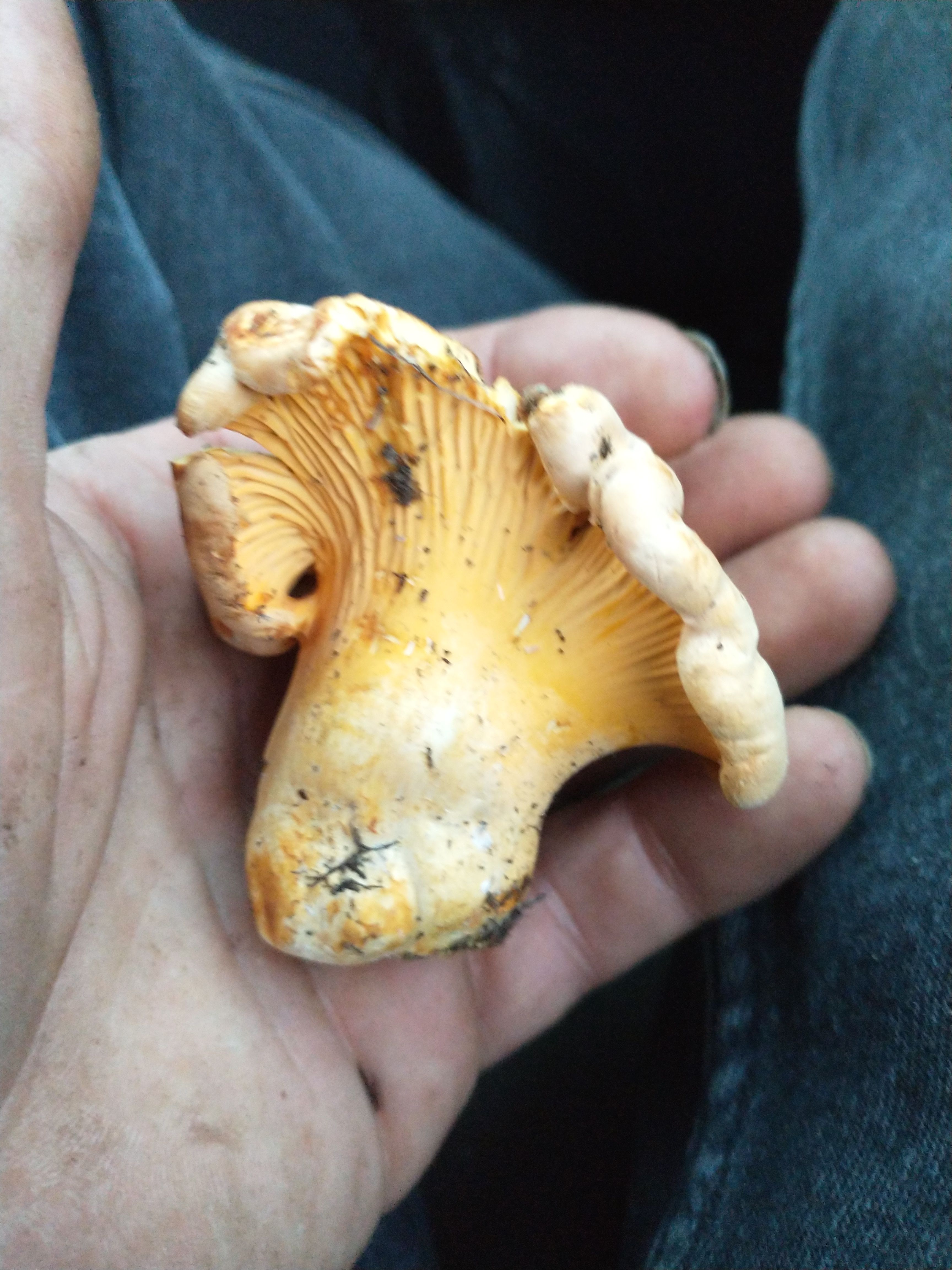
Golden Chanterelle
Cantharellus formosus
Harvest Details
Pacific Golden Chanterelles are native to western North America and are strongly associated with the conifer forests of the Pacific Northwest.
They occur in forest-floor habitats where their underground mycelium forms ectomycorrhizal relationships with living trees.
Important associated trees include:
Douglas-fir • Western hemlock • Sitka spruce • Other compatible PNW conifers
They may occur in both second-growth and older forests when suitable host trees, soil, moisture, and stand conditions are present. USDA sources describe C. formosus as widespread from coastal northern California north through Oregon and Washington into British Columbia. �
ScienceDirect +1
Unlike many decomposer mushrooms, chanterelles should not be described as growing from logs, stumps, or dead wood. Their fruiting bodies emerge from the forest floor while the fungus lives in association with tree roots.
Primary Season: Summer through fall, with the strongest regional production dependent on rainfall, soil moisture, elevation, temperature, and location.
For much of the Pacific Northwest, fall is the major chanterelle season. USDA regional material specifically documents C. formosus fruiting during cool, moist conditions and gives September through November for regional collections. �
US Forest Service +1
Productive locations can fruit repeatedly across years because harvesting removes the temporary fruiting body rather than the entire perennial underground fungal organism.
Pacific Northwest / Western North America
Pacific Golden Chanterelle habitat extends through the moist conifer forests of the Pacific coastal region, including portions of:
Northern California • Oregon • Washington • British Columbia
Within this range, distribution is not uniform. Local abundance depends heavily on compatible host trees, forest structure, soils, moisture, elevation, temperature, and previous forest disturbance.
Douglas-fir and western-hemlock forests are particularly important habitats. Sitka spruce is another documented associate. �
Pacific Golden Chanterelles generally have yellow-orange to orange fruiting bodies with caps that become irregular, wavy, or funnel-shaped as they mature.
One of their most important field characteristics is underneath the cap.
False Gills
Chanterelles do not have ordinary thin, blade-like true gills.
Instead, the underside contains blunt, forked, vein-like folds or ridges commonly called false gills.
These ridges run downward onto the stem—known as decurrent ridges.
This characteristic is extremely important when distinguishing chanterelles from superficially similar mushrooms. �
US Forest Service
Cap
Approximately 3–15 cm wide in the USDA regional description.
Young caps may be convex or relatively flat before becoming irregular, wavy, depressed, or funnel-shaped with maturity.
Color ranges through yellow-orange and orange tones and can vary with age and environmental conditions. �
US Forest Service
Stem
Solid rather than hollow.
Typically narrows gradually into the cap without a sharply defined separation between cap and stem.
USDA regional descriptions give approximately 2–10 cm long and 0.5–3 cm wide. �
US Forest Service
Flesh
Firm and substantial compared with many thin-gilled mushrooms.
The interior flesh is generally paler than the external surface.
Aroma
Fresh specimens commonly have a pleasant fruity fragrance frequently compared with apricots. �
US Forest Service
Aroma should support identification but never be used by itself to determine edibility.
Spore Print
Creamy to yellowish/pale depending on the specimen and source description. �
US Forest Service
Important Identification Warning
Color alone should never be used to identify a chanterelle.
A proper identification should consider:
Habitat + growth from the ground + cap structure + blunt false gills + decurrent ridges + solid stem + flesh + odor + spore characteristics + regional species
Look-alike mushrooms exist, including mushrooms with true blade-like gills.
Never consume or sell a wild mushroom unless its identity has been confidently established.
Recipes & Pairings
Ready to source Golden Chanterelle?
Browse active lots from verified foragers in the marketplace.
