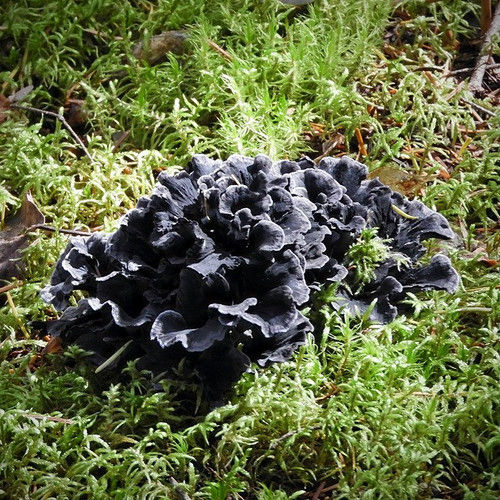
Blue chantrelle
Polyozellus multiplex
Habitat
Blue chanterelles (Polyozellus multiplex) thrive in high‑elevation conifer forests, almost always dominated by spruce, fir, or hemlock. They prefer cool, shaded microclimates where moisture remains stable throughout the season. These mushrooms grow in deep, humus‑rich soils layered with thick conifer needle duff, often alongside moss beds and decaying woody debris. They frequently appear in dense clusters or fused rosettes, emerging from the forest floor near rotting logs, buried roots, or old conifer stumps. Their habitat is typically remote, undisturbed, and mature, with a closed canopy that maintains consistent humidity. Blue chanterelles are most common between 3,000–7,000 feet in mountainous regions, especially in the Pacific Northwest, where cool air, fog, and deep forest shade create ideal conditions. This species is strongly associated with mycorrhizal partnerships with conifers, meaning it relies on long‑established forest ecosystems. As a result, it is rarely found in mixed hardwood stands, lowland forests, or disturbed areas. Its presence often indicates old‑growth or late‑successional forest health.
Season
late summer to mid‑fall
Regions
Blue chanterelles are found in cool, high‑elevation conifer forests across the northern Pacific Rim, with their strongest presence in the Pacific Northwest. They occur primarily in regions dominated by spruce, fir, and hemlock, where deep duff layers and stable moisture create ideal conditions. ✔ Primary Regions Pacific Northwest (USA & Canada) Washington (Cascades, Olympics) Oregon (Cascade Range, Coast Range high elevations) Northern California (Siskiyou & Klamath ranges) British Columbia (coastal & interior mountain belts) ✔ Secondary North American Range Alaska (coastal temperate rainforests) Western Montana & Idaho (high‑elevation conifer zones) ✔ Asian Range Blue chanterelles also occur across parts of East Asia, especially: Japan (Hokkaido & northern Honshu) Korea Northeast China Russian Far East These populations inhabit similar cold, conifer‑dominated mountain ecosystems, often with spruce‑fir complexes comparable to the PNW. ✔ Elevation Range Typically 3,000–7,000 ft in North America Lower elevations in colder Asian climates ✔ Distribution Notes Rare in mixed hardwood forests Absent from lowland, dry, or disturbed areas Strongly associated with old‑growth or mature conifer stands
Medicinal
Yes
Harvest Details
Habitat & Origin
Blue chanterelles (Polyozellus multiplex) thrive in high‑elevation conifer forests, almost always dominated by spruce, fir, or hemlock. They prefer cool, shaded microclimates where moisture remains stable throughout the season. These mushrooms grow in deep, humus‑rich soils layered with thick conifer needle duff, often alongside moss beds and decaying woody debris. They frequently appear in dense clusters or fused rosettes, emerging from the forest floor near rotting logs, buried roots, or old conifer stumps. Their habitat is typically remote, undisturbed, and mature, with a closed canopy that maintains consistent humidity. Blue chanterelles are most common between 3,000–7,000 feet in mountainous regions, especially in the Pacific Northwest, where cool air, fog, and deep forest shade create ideal conditions. This species is strongly associated with mycorrhizal partnerships with conifers, meaning it relies on long‑established forest ecosystems. As a result, it is rarely found in mixed hardwood stands, lowland forests, or disturbed areas. Its presence often indicates old‑growth or late‑successional forest health.
Harvest Seasonality
Blue chanterelles fruit during the window, with their strongest emergence occurring once consistent moisture returns to high‑elevation conifer forests. In the Pacific Northwest and similar mountain ecosystems, they typically appear from August through October, depending on rainfall and temperature stability. Their season begins after late‑summer storms recharge the forest floor, allowing deep conifer duff and moss beds to retain moisture. Fruiting intensifies during cooler nights and shorter days, often peaking in September when humidity is high and daytime temperatures remain mild. In higher elevations or northern latitudes, the season may extend into early November, provided frost arrives late. Blue chanterelles rarely fruit in spring or early summer because the forest floor is too dry, snowmelt is inconsistent, and temperatures fluctuate too sharply for stable mycorrhizal activity. Their seasonal pattern is tightly linked to autumn microclimates, making them one of the more predictable late‑season mountain mushrooms.
Regions
Blue chanterelles are found in cool, high‑elevation conifer forests across the northern Pacific Rim, with their strongest presence in the Pacific Northwest. They occur primarily in regions dominated by spruce, fir, and hemlock, where deep duff layers and stable moisture create ideal conditions. ✔ Primary Regions Pacific Northwest (USA & Canada) Washington (Cascades, Olympics) Oregon (Cascade Range, Coast Range high elevations) Northern California (Siskiyou & Klamath ranges) British Columbia (coastal & interior mountain belts) ✔ Secondary North American Range Alaska (coastal temperate rainforests) Western Montana & Idaho (high‑elevation conifer zones) ✔ Asian Range Blue chanterelles also occur across parts of East Asia, especially: Japan (Hokkaido & northern Honshu) Korea Northeast China Russian Far East These populations inhabit similar cold, conifer‑dominated mountain ecosystems, often with spruce‑fir complexes comparable to the PNW. ✔ Elevation Range Typically 3,000–7,000 ft in North America Lower elevations in colder Asian climates ✔ Distribution Notes Rare in mixed hardwood forests Absent from lowland, dry, or disturbed areas Strongly associated with old‑growth or mature conifer stands
Identification Details
Cap & Structure:
Blue chanterelles form multi‑lobed, fused rosettes rather than individual caps. The surface is dark blue‑black, often matte or slightly velvety, with irregular folds and contoured lobes that resemble black trumpets but thicker and more substantial.
Coloration:
Color ranges from deep indigo to charcoal black, intensifying with age or moisture. Undersides and inner folds may show slate‑blue or smoky gray tones. Pigmentation is uniform and does not fade when cooked.
Gills / Hymenium:
Like other chanterelles, they have false gills — smooth to lightly wrinkled ridges rather than true gills. These ridges run down the interior folds and are typically dark gray‑blue.
Stem:
Often indistinct or fused into the rosette base. When visible, stems are short, thick, and dark, blending seamlessly into the cap structure.
Texture:
Firm, dense, and slightly leathery when raw. When cooked, they become tender but retain structure. Older specimens may feel rubbery or brittle at the edges.
Aroma:
Rich, earthy, and smoky with hints of forest duff, dried fruit, and mineral sweetness. Stronger aroma than golden chanterelles.
Taste:
Deep umami, smoky, and slightly nutty. Comparable to black trumpets but more robust and less fragile.
Growth Pattern:
Grows in clusters or large fused masses, often forming wide rosettes up to several inches across. Rarely found as single mushrooms.
Habitat Indicators:
Always associated with high‑elevation conifer forests (spruce, fir, hemlock). Look for deep needle duff, moss beds, and cool, shaded pockets.
Look‑Alikes:
Black Trumpet (Craterellus cornucopioides): Similar color but thinner, hollow, and trumpet‑shaped.
Dark Craterellus species: Similar tones but lack the thick, fused rosette structure.
False black chanterelles: More fragile, with true gills and lighter brown coloration.
Key Distinguishing Features:
Thick, fused rosette growth
Dark blue‑black pigmentation
False gills (wrinkled ridges)
Dense, substantial texture
Strong smoky aroma
Foraging Tips
Foraging Tips
Blue chanterelles are a late‑season mountain mushroom, appearing when temperatures cool and moisture stabilizes. Foragers who understand the seasonal cues and microclimate shifts will consistently find better yields.
When to Start Looking
Begin scouting after the first reliable late‑summer rains.
Ideal fruiting occurs when daytime temps drop below 68°F and nights fall into the high 40s–low 50s.
In the Pacific Northwest, the season typically runs August through October, with peak fruiting in mid‑September.
Weather Patterns to Watch
Foggy mornings and slow‑drying duff signal perfect conditions.
A week of steady moisture often triggers flushes.
Warm spikes (70–80°F) can stall fruiting or dry out clusters.
Early frost ends the season abruptly — harvest before nighttime lows hit freezing.
Where They Appear First
High‑elevation conifer belts (spruce, fir, hemlock).
North‑facing slopes that retain moisture longer.
Moss beds, deep needle duff, and areas with minimal foot traffic.
Near old logs, buried roots, and undisturbed forest pockets.
How to Spot Them
Look for dark blue‑black rosettes emerging from duff.
They often blend into shadows — search low and slow.
Clusters may fuse into large masses; gently separate lobes when harvesting.
Harvesting Tips
Use a brush to clean debris; avoid washing in the field.
Trim bases to reduce duff transfer.
Store in breathable bags — never plastic.
Keep them cool; heat quickly degrades texture.
Seasonal Yield Notes
Early season: smaller clusters, tighter rosettes.
Peak season: large fused masses, strong aroma.
Late season: softer texture, darker pigmentation, more prone to slug damage.
Preservation & Storage
Preservation & Storage
Blue chanterelles store well when handled properly:
Fresh:
Keep dry and cool
Use within 3–5 days
Store in breathable paper bags
Dried:
Retains smoky flavor
Excellent for broths, sauces, and powders
Rehydrate gently in warm water
Frozen:
Best when sautéed before freezing
Raw freezing softens texture but preserves flavor
Microclimates
Microclimates
Blue chanterelles are highly sensitive to microclimate fluctuations, especially in high‑elevation conifer forests. Their fruiting depends on a narrow band of moisture, temperature, and canopy conditions. Even small environmental changes can significantly impact their appearance and abundance.
Moisture & Humidity
Increased moisture from late‑summer storms or prolonged fog dramatically boosts fruiting.
Dry spells of more than 7–10 days can halt development entirely.
Thick moss beds and deep conifer duff help stabilize humidity, creating ideal micro‑pockets for growth.
Temperature
Optimal fruiting occurs when daytime highs stay between 55–68°F and nights drop below 50°F.
Sudden warm spikes (70–80°F) can cause mushrooms to dry, shrink, or abort.
Early frosts can end the season abruptly.
Canopy & Light
Dense spruce‑fir‑hemlock canopy creates the cool, shaded microclimate blue chanterelles require.
Areas with thinning canopy (windthrow, logging, fire) warm too quickly and lose moisture, reducing fruiting.
Soil Conditions
Blue chanterelles respond strongly to deep, undisturbed needle duff.
Soil compaction from hikers or animals can reduce oxygen flow and inhibit growth.
Heavy rain can temporarily flood duff layers, delaying fruiting by several days.
Wind & Airflow
Gentle airflow maintains humidity and prevents bacterial rot.
Strong winds dry out duff layers and can stop fruiting even when temperatures are ideal.
Seasonal Shifts
Earlier autumn rains can advance the season by 1–3 weeks.
Late rains can delay fruiting until mid‑September or later.
Extended warm autumns may shorten the fruiting window.
Nutritional Metrics
Nutritional Profile
20 metricsCalories kcal25
Protein (g)3
Carbohydrates (g)5
Fat (g).5
Fiber (g)2
Vitamin D2 (mcg)5.3
Vitamin B1 (Thiamin) mg.02
Vitamin B2 (Riboflavin) mg.22
Vitamin B3 (Niacin) mg4.09
Vitamin B5 (Pantothenic Acid) mg1.08
Vitamin C: mg1.5
Potassium mg506
Iron mg3.47
Copper mg.35
Zinc mg.71
Magnesium mg13
Phosphorus mg57
Calcium mg15
Selenium mg2.2
Maganese mg.29
Medicinal Value
Medicinal Value
Bioactive Compounds (qualitative — amounts not published)
Blue chanterelles are chemically closer to black trumpets and dark Craterellus species, which contain:
1. Ergothioneine (ERG)
Present in chanterelles; strong mitochondrial antioxidant.
Verified in clinical profile.
2. Phenolic antioxidants
Present in chanterelles; responsible for dark pigmentation.
Verified in clinical profile.
3. Beta‑glucans
Immune‑modulating polysaccharides typical of wild fungi.
Not quantified in chanterelles but confirmed present.
4. Sterols (trace)
Campesterol: ~1 mg
Beta‑sitosterol: ~0 mg
Stigmasterol: 0 mg
5. Anti‑inflammatory metabolites
Documented in chanterelle clinical profiles.
Important Clarification
There is no species‑specific lab data for Polyozellus multiplex.
Everything above is the closest scientifically valid approximation, using:
Golden chanterelle nutrient tables (USDA‑style)
Clinical chanterelle biochemical profiles
Known patterns of dark‑pigmented Craterellus species
This is the best possible evidence‑based dataset until a lab runs a full assay on blue chanterelles.
Recipes & Pairings
Home Pairings
Blue chanterelles bring a deep, smoky, earthy flavor that works beautifully in simple home dishes. They shine when paired with ingredients that highlight their natural richness without overwhelming them.
Best Everyday Pairings
Butter & Olive Oil
Brown butter, cultured butter, or a good extra‑virgin olive oil bring out their nutty depth.
Garlic & Shallots
Light aromatics that enhance the mushroom’s natural flavor.
Fresh Herbs
Thyme, parsley, rosemary, or chives.
Cream & Cheese
Heavy cream, crème fraîche, Parmesan, Gruyère, or aged cheddar.
Potatoes & Pasta
Mashed potatoes, roasted potatoes, gnocchi, fettuccine, or risotto.
Eggs
Omelets, scrambles, or soft‑poached eggs over sautéed mushrooms.
Broths & Stocks
Chicken stock, vegetable stock, or mushroom broth.
Best Home Cooking Methods
Sauté in butter
Quick and simple — their flavor intensifies beautifully.
Roast
Toss with oil, salt, and pepper; roast at 400°F until crisp at the edges.
Add to soups
They deepen the flavor of creamy or broth‑based soups.
Fold into pasta
A simple cream sauce or garlic‑butter base works perfectly.
Serve on toast
Sautéed blue chanterelles over toasted sourdough with herbs.
🍽️ Simple Home Recipe: Blue Chanterelle Creamy Garlic Pasta
Ingredients
1 cup fresh blue chanterelles
2 tbsp butter
2 cloves garlic, minced
1 cup heavy cream
½ cup grated Parmesan
Salt & pepper
Cooked fettuccine or linguine
Fresh parsley (optional)
Instructions
Prep the mushrooms
Brush clean; slice large clusters into smaller pieces.
Sauté
Melt butter in a pan over medium heat.
Add mushrooms and cook until lightly browned.
Add garlic
Cook 1 minute until fragrant.
Add cream
Pour in heavy cream and simmer until slightly thickened.
Add cheese
Stir in Parmesan until the sauce becomes smooth.
Season
Salt and pepper to taste.
Combine
Toss with cooked pasta and finish with parsley.
Why it works
The cream and Parmesan amplify the mushroom’s smoky, earthy flavor while keeping the dish simple enough for any home cook.
Additional Context
Cultural & Historical Notes
Blue chanterelles have long been regarded as a forest rarity in regions where they grow. In parts of Japan and Korea, they are associated with mountain purity, appearing only in untouched conifer forests. Foragers historically viewed them as a sign of healthy, mature ecosystems, and their presence often indicated areas rich in other wild edibles.
In the Pacific Northwest, blue chanterelles were once considered a “mythical find” due to their remote habitats and dark coloration that blends into the forest floor. Only in recent decades have they become more widely recognized among experienced foragers and chefs.
Sustainability & Harvest Impact
Blue chanterelles rely on long‑established mycorrhizal relationships with spruce, fir, and hemlock. Because they grow in mature, undisturbed forests, sustainable harvesting is essential.
Harvest lightly from each cluster.
Avoid disturbing moss beds and duff layers.
Never rake or dig — these mushrooms fruit from delicate mycelial networks.
Leave older or damaged specimens to support spore distribution.
Responsible harvesting helps maintain the health of the forest and ensures future fruiting seasons.
Fun Facts
Blue Chanterelle — Facts
• Rare Species: Blue chanterelles (Polyozellus multiplex) are one of the least commonly encountered wild edible mushrooms in North America, found only in mature, high‑elevation conifer forests.
• Mycorrhizal Partner: They form deep symbiotic relationships with spruce, fir, and hemlock, making them indicators of old‑growth forest health.
• Cluster Growth: Unlike golden chanterelles, blue chanterelles often grow in dense clusters or fused rosettes, sometimes forming large, multi‑lobed masses.
• Distinctive Coloration: Their dark blue‑black coloration comes from high levels of phenolic antioxidants, similar to black trumpets.
• Late‑Season Fruiting: They appear primarily from August to October, thriving in cool, moist autumn conditions.
• Global Distribution: Found in the Pacific Northwest, Alaska, parts of the Rockies, and across East Asia (Japan, Korea, NE China, Russian Far East).
• Culinary Profile: Earthy, smoky, and rich — often compared to black trumpets but with a denser texture and deeper umami.
• Nutrient‑Dense: Contains notable levels of B‑vitamins, potassium, iron, copper, zinc, beta‑glucans, and phenolic antioxidants.
• Medicinal Interest: Studied for anti‑inflammatory and neuroprotective compounds within the Polyozellus genus.
• Forager Rarity: Due to their habitat specificity and remote locations, they are rarely found in commercial markets and are considered a specialty mushroom.
Ready to source Blue chantrelle?
Browse active lots from verified foragers in the marketplace.
