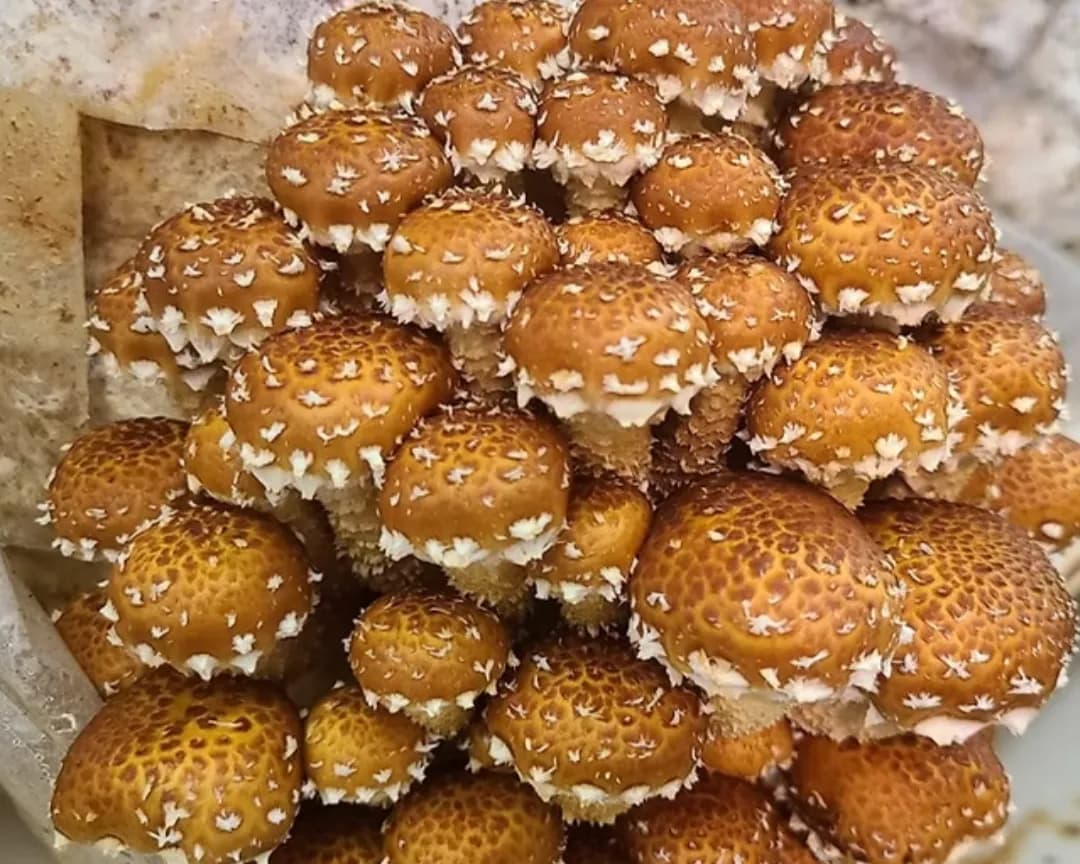
Chestnut
Pholiota adiposay
Harvest Details
Chestnut mushrooms (Pholiota adiposa) are wood‑decaying fungi strongly associated with dead or dying hardwoods in temperate forests. They typically grow in dense, attractive clusters on fallen logs, stumps, standing deadwood, and large woody debris, especially where moisture is consistently retained.
In the wild, Chestnuts favor deciduous hosts such as oak, beech, birch, maple, and other broadleaf species. Their fruiting is closely tied to the condition of the wood: they colonize weakened or decomposing trunks and branches, breaking down lignin and cellulose as part of the natural forest recycling process.
Moisture plays a major role in their development. Productive logs often occur in shaded forest pockets, riparian corridors, creek bottoms, and areas with stable humidity, where wood remains damp enough to support sustained fungal growth. Chestnut mushrooms may fruit repeatedly from the same log as long as suitable substrate remains.
Appearance and growth patterns vary with temperature, humidity, elevation, host species, and microclimate. Cooler, moist conditions typically produce firmer, more vividly colored caps, while warmer or drier conditions can lead to paler coloration, reduced clustering, or smaller fruit bodies.
Pholiota adiposa is native to temperate regions of the Northern Hemisphere, with wild populations documented across Europe, Asia, and North America. In the Pacific Northwest, Chestnut mushrooms occur in hardwood‑supporting habitats throughout Washington, Oregon, Idaho, and surrounding areas, though distribution is highly localized and dependent on the presence of suitable host wood.
Chestnut mushrooms are also cultivated by specialty growers. Indoor production uses pasteurized or sterilized hardwood sawdust, supplemented substrates, or lignocellulosic agricultural materials, allowing growers to reproduce the cool, humid conditions required for consistent fruiting.
As with many wood‑decaying fungi, local environmental variation can significantly influence color, size, density, texture, and yield, making Chestnut mushrooms a species with notable ecological and culinary diversity.
Chestnut mushrooms (Pholiota adiposa) fruit most reliably during cool, moist periods when hardwood substrates retain sufficient moisture to support fungal development. In many temperate regions, they are strongly associated with late summer through autumn, though fruiting can extend into early winter when temperatures remain mild and humidity is sustained.
In the Pacific Northwest and Inland Northwest, timing varies significantly by elevation, forest type, and microclimate. Lower‑elevation hardwood stands may produce Chestnut mushrooms from August into October, while shaded creek bottoms, riparian corridors, and moisture‑retaining forest pockets can support fruiting later into the season. Higher elevations or exposed hardwood habitats may show a shorter window, with fruiting concentrated in early fall.
Rainfall and sustained humidity are major triggers. After periods of steady rain, productive logs often produce dense clusters, especially when daytime temperatures remain cool and nighttime temperatures drop enough to slow evaporation. Extended dry periods can delay or halt fruiting until moisture returns.
Chestnut mushrooms frequently fruit from the same log or stump across multiple years, provided the substrate remains structurally intact and moisture conditions are favorable. Individual logs may produce multiple flushes within a single season when rainfall patterns create repeated cycles of hydration.
Cultivated Chestnut mushrooms are not restricted to natural seasonal patterns. Indoor growers can produce them year‑round by controlling temperature, humidity, fresh‑air exchange, lighting, and substrate moisture, allowing consistent harvests independent of outdoor conditions.
As with many wood‑decaying fungi, local variation is substantial. Two nearby hardwood stands may show different fruiting windows due to differences in shade, wind exposure, substrate moisture, and host species. Foragers should evaluate timing at the microhabitat level rather than assuming uniform seasonality across an entire region.
Chestnut mushrooms (Pholiota adiposa) occur across temperate regions of the Northern Hemisphere, with wild populations documented throughout Europe, Asia, and North America. Their distribution is closely tied to the presence of suitable hardwood hosts, moisture‑retaining forest conditions, and the availability of decaying wood at various stages of decomposition.
Within the Pacific Northwest, Chestnut mushrooms can be found in hardwood‑supporting habitats across Washington, Oregon, Idaho, and surrounding areas, though their occurrence is highly localized. Productive habitat is often concentrated in riparian corridors, creek bottoms, shaded forest pockets, and mixed deciduous stands where moisture remains stable and hardwood logs persist long enough to support colonization.
As with many wood‑decaying fungi, distribution should be evaluated at the microhabitat level rather than assumed uniformly across an entire region. Two nearby forest areas may differ significantly due to variations in host species, shade, wind exposure, substrate moisture, elevation, and forest structure. Logs in shaded depressions or near water sources may support repeated fruitings, while exposed hardwood stands may produce fewer or shorter‑season occurrences.
Chestnut mushrooms are also cultivated by specialty growers. Indoor production allows growers to reproduce the cool, humid, hardwood‑substrate conditions required for fruiting, resulting in a commercial distribution that is broader than their wild range. Cultivated Chestnuts may be available year‑round even when wild fruitings are limited to late summer and autumn.
Overall, Pholiota adiposa is a species whose regional presence depends heavily on local hardwood availability, moisture patterns, and forest microclimates, making it a mushroom that rewards careful habitat‑based searching rather than broad regional assumptions.
Chestnut mushrooms are recognized by their golden‑brown caps, fine surface scales, and dense clustered growth on decaying hardwoods. Their appearance is consistent across most fruitings, but environmental conditions can influence color intensity, cluster size, and cap texture.
Cap
Color: Golden‑brown to chestnut‑amber
Surface: Dry, with fine, fibrous scales (never slimy)
Shape: Convex when young, flattening with age
Size: Typically 2–6 cm across
Texture: Firm, slightly crisp when young; softens as clusters mature
Gills
Attachment: Adnate to slightly decurrent
Color: Pale yellow to brownish as spores mature
Spacing: Moderately close
Structure: Smooth, even, and consistent across the cluster
Stem
Color: Pale yellow‑brown, often lighter than the cap
Surface: Fibrous, sometimes with faint scaling
Shape: Straight or slightly curved, 3–7 cm long
Cluster Behavior: Stems often fuse at the base where attached to the wood
Growth Habit
Clustered: Chestnuts grow in dense, layered clusters, often forming shelves or overlapping tiers
Substrate: Exclusively on decaying hardwood logs, stumps, and fallen branches
Fruiting Pattern: Multiple clusters may appear on the same log or adjacent debris
Spore Print
Color: Brown
Texture: Fine, powdery
Aroma & Flavor
Aroma: Nutty, earthy, slightly sweet
Flavor: Rich, savory, and meaty with strong browning potential
Environmental Indicators
Chestnuts are most often found in:
Moist hardwood pockets
Creek bottoms and riparian corridors
Shaded forest depressions
Logs in mid‑stage decay
These microhabitats maintain the moisture required for strong cluster formation.
Look‑Alikes
Chestnuts can be confused with other Pholiota species. Avoid:
Slimy‑capped Pholiota (Chestnuts are always dry‑capped)
Species with bitter or foul odors
Mushrooms with greenish or orange‑slimy caps
Correct identification relies heavily on the dry, scaly cap texture and clustered hardwood growth.
Key Identifiers (Quick Check)
Golden‑brown, dry, scaly caps
Dense clusters on hardwood
Firm, meaty texture
Brown spore print
Nutty aroma
Never slimy
Foraging Tips
Chestnut mushrooms fruit during late summer through autumn, with their best flushes appearing after periods of steady rainfall followed by cool nights. Their season is strongly tied to moisture retention in hardwood logs, making microhabitat selection essential for consistent finds.
1. Track Rainfall Patterns
Chestnuts respond quickly to multi‑day rain events.
Ideal conditions:
Day temps 55–70°F
Night temps 40s–50s°F
Logs that stay damp for several days
A single warm, dry spell can pause fruiting until moisture returns.
2. Target the Right Wood
Chestnuts grow almost exclusively on decaying hardwoods, especially:
Oak
Beech
Birch
Maple
Poplar
Other broadleaf species
Look for mid‑stage decay—logs that are softening but still structurally intact.
3. Search Moist Forest Pockets
Prime microhabitats include:
Creek bottoms
Riparian corridors
Shaded depressions
North‑facing slopes
Fallen logs under dense canopy
Logs that stay cool and damp produce the most reliable clusters.
4. Look for Cluster Patterns
Chestnuts fruit in dense, layered clusters. When you find:
Slow down
Scan the entire log
Check both sides and underneath
Inspect nearby logs within 20–40 feet
Multiple clusters often appear on the same piece of wood or adjacent debris.
5. Watch Color & Texture
Fresh Chestnuts show:
Golden‑brown caps
Fine surface scales
Firm, meaty texture
Tight clustering
Over‑mature clusters become darker, softer, and may show insect activity.
6. Harvest Carefully
Chestnuts detach cleanly when lifted from the base.
Best practice:
Trim the tough attachment point
Keep clusters intact when possible
Brush debris off immediately
Avoid soaking—water ruins browning and texture
7. Storage Tips
Store in paper bags, never plastic
Keep cool and dry
Use within 3–5 days for best quality
For longer storage, sauté lightly and freeze
8. Know the Season Shifts
Early season: Smaller clusters, firmer caps
Peak season: Large, dense clusters with strong nutty aroma
Late season: More insect pressure, softer caps, darker coloration
9. Avoid Look‑Alikes
Several Pholiota species resemble Chestnuts. Avoid:
Slimy‑capped Pholiota species
Bitter or foul‑smelling clusters
Logs with mixed species—verify cap texture and color carefully
Chestnuts have dry, scaly caps, not slimy or sticky.
Preservation & Storage
Chestnut mushrooms store well when handled properly, maintaining their firm texture and nutty flavor for several days. Their dry, scaly caps help resist moisture loss, but they can soften quickly if exposed to humidity or sealed in airtight containers.
Short‑Term Storage (Fresh)
Store in a paper bag or breathable container
Keep refrigerated at 34–38°F
Avoid plastic bags or sealed containers—Chestnuts will sweat and soften
Do not wash before storage; brush debris off instead
Use within 3–5 days for best quality
Chestnuts maintain their meaty texture better than many delicate mushrooms, but their clustered bases can trap moisture if not trimmed.
Pre‑Storage Prep
Trim the tough cluster base
Separate mushrooms to allow airflow
Remove any overly soft or insect‑damaged pieces
Keep caps dry to preserve browning ability
Freezing
Chestnuts freeze well .
Recommended method:
Sauté lightly in butter or oil
Cool completely
Freeze in a single layer
Transfer to airtight containers
Frozen Chestnuts retain excellent flavor and can be added directly to hot pans, soups, or sauces.
Drying
Chestnuts can be dehydrated, though their firm texture means they dry more slowly than thin‑fleshed species.
Slice caps for faster drying
Dry at 125–135°F until crisp
Store in airtight jars away from light
Rehydrated Chestnuts develop a deeper, concentrated nutty flavor ideal for soups, sauces, and braises.
Pickling
Chestnuts hold their texture well in pickling brines.
Best for:
Charcuterie boards
Sandwiches
Savory salads
Chef applications requiring acidity and firmness
Oil Preservation
Chestnuts can be preserved in oil after a brief sauté or blanch.
Important:
Always refrigerate oil‑preserved mushrooms
Use within 7–10 days
Never store raw mushrooms in oil (botulism risk)
Culinary Quality Over Time
Day 1–2: Firm, meaty, ideal for browning
Day 3–4: Slight softening, still excellent for sautéing and roasting
Day 5+: Best used in soups, sauces, or cooked dishes
Retail & Forager Tip
Chestnuts with intact clusters and dry caps store longer than broken or moisture‑exposed mushrooms. Keeping them dry is the single most important factor in preserving quality.
Microclimates
Chestnut mushrooms respond strongly to local microclimate shifts, and even small changes in moisture, temperature, or airflow can alter their appearance, density, and fruiting behavior. Because they grow on hardwood logs and stumps rather than soil, their microclimate is shaped heavily by the condition of the wood itself.
Moisture & Humidity
Chestnuts require consistent moisture in their host wood. Logs in shaded creek bottoms, riparian corridors, or depressions fruit more reliably than those in exposed areas.
• High moisture → denser clusters, deeper coloration, firmer caps
• Low moisture → smaller clusters, paler caps, reduced yield
Sudden dry spells can halt fruiting until rainfall rehydrates the substrate.
Temperature
Chestnuts prefer cool to mild temperatures, especially during late summer and autumn.
• Cooler nights → stronger browning, tighter clusters
• Warm spells → faster growth but lighter coloration
Extreme heat can cause caps to dry or crack, reducing quality.
Airflow & Exposure
Airflow affects both moisture retention and cap development.
• Low airflow (dense forest pockets) → larger clusters, slower drying
• Moderate airflow → ideal for preventing rot while maintaining moisture
• High airflow (ridge lines, exposed logs) → rapid drying, reduced fruiting
Logs shielded by vegetation or terrain produce more consistent flushes.
Light
Chestnuts tolerate a wide range of light conditions but perform best in dappled shade.
• Deep shade → darker caps, slower growth
• Partial shade → balanced growth and color
• Full sun → rapid drying of substrate, shortened fruiting window
Substrate Condition
The condition of the hardwood log is of the most important microclimate factors.
• Freshly fallen logs → slow colonization, delayed fruiting
• Mid‑stage decay → ideal moisture and nutrient availability
• Advanced decay → reduced structural integrity, smaller flushes
Logs that remain intact and moist can fruit for multiple seasons.
Elevation
Elevation influences temperature swings and humidity retention.
• Lower elevations → longer fruiting window
• Mid elevations → strong autumn fruiting
• Higher elevations → short, intense fruiting periods tied to rainfall
Rainfall Patterns
Chestnuts often fruit after sustained rainfall, especially when followed by cool nights.
• Multiple rain cycles → multiple flushes
• Heavy rain + warm temps → softer caps, faster breakdown
• Light rain + cool temps → ideal texture and color
Nutritional Metrics
Medicinal Value
Chestnut mushrooms contain several compounds being investigated for potential health‑related properties, including beta‑glucans, dietary fiber, phenolic antioxidants, ergothioneine, and other bioactive molecules common to wood‑decaying fungi.
Beta‑glucans from fungi have received particular research attention for their interactions with immune function, inflammation pathways, and gut microbiome activity. While Pholiota species are less extensively studied than Pleurotus or Lentinula, early analyses show comparable beta‑glucan profiles that may contribute to similar physiological effects.
Laboratory and preliminary clinical research on Pholiota species has explored potential influences on glucose metabolism, lipid regulation, and antioxidant activity. Some studies report favorable changes in oxidative stress markers and metabolic parameters, but the evidence remains limited by small sample sizes, species variability, and methodological constraints.
Chestnut mushrooms should therefore be regarded primarily as a nutritious edible food rather than a treatment or cure for disease. Their bioactive compounds are promising, but current research does not support therapeutic claims.
Research Areas
• Beta‑glucans and immune modulation
• Dietary fiber and digestive health
• Antioxidant compounds (phenolics, ergothioneine)
• Glucose metabolism
• Lipid metabolism
• Gut microbiome interactions
Evidence Status
Promising early research, but additional high‑quality human clinical trials are needed. Current findings should be interpreted cautiously and viewed as supportive of general wellness rather than specific medical outcomes.
Recipes & Pairings
Chestnut mushrooms have a rich, nutty, savory flavor and a firm, meaty texture that holds up beautifully in everyday cooking. Their golden‑brown caps caramelize easily, and their natural structure makes them ideal for sautéing, roasting, and adding to familiar home dishes.
Chestnuts are excellent for cooks who want a mushroom that feels hearty and flavorful without requiring complicated preparation. They brown quickly, develop deep flavor, and pair well with pantry staples you already have at home.
Great Home Pairings
Fats: Butter • olive oil • avocado oil
Herbs & Seasonings: Garlic • • thyme • rosemary • parsley • black pepper • smoked paprika
Cheese & Dairy: Parmesan • mozzarella • cheddar • cream • sour cream
Vegetables: Potatoes • • spinach • carrots • peppers • broccoli • tomatoes
Other Pairings: Eggs • pasta • rice • bread • chicken • steak • soy sauce • lemon • sesame
Before Cooking
Trim away the tough base where the cluster was attached to the wood or substrate.
Separate mushrooms by hand or tear larger caps into pieces.
If cleaning is needed, gently brush debris away or wipe with a slightly damp towel.
Avoid soaking—Chestnuts absorb water and won’t brown properly.
For best caramelization, give them plenty of space in the pan.
RECIPE — GARLIC‑BUTTER CHESTNUT MUSHROOMS
Serves: 2–3
Prep Time: 5 minutes
Cook Time: 8–10 minutes
Ingredients
8 oz Chestnut mushrooms
2 tbsp butter
2 cloves garlic, minced
1/4 tsp salt (or to taste)
Freshly ground black pepper
1 tsp fresh lemon juice
1 tbsp chopped parsley (optional)
Instructions
Prepare the mushrooms.
Trim the tough base. Separate mushrooms and tear larger in half.Heat the pan.
Place a large skillet over medium‑high heat.Brown the mushrooms.
Add the mushrooms in a loose single layer.
Cook 2–3 minutes without stirring, then turn and continue cooking until golden.Add butter and garlic.
Add the butter. melted, add the garlic.
Cook 2–3 more minutes until the mushrooms are browned and edges crisp.Season.
Add salt and pepper.
Finish with lemon juice and parsley if desired.
Serving Ideas
Serve with eggs, steak, chicken, potatoes, pasta, rice, roasted vegetables, or spoon over toasted bread.
Home Cook Tip
Don’t crowd the skillet. If making a large batch, cook in two rounds so the mushrooms brown instead of steam.
Additional Context
Chestnut mushrooms have a long presence in temperate forests across Europe, Asia, and North America, where they have historically been recognized more for their visual appeal and ecological role than for widespread culinary use. Their warm golden‑brown caps and dense clustered growth made them a familiar sight to traditional foragers, woodcutters, and rural communities who spent time around hardwood stands and decaying logs.
In parts of Europe, especially Central and Eastern regions, Chestnut mushrooms were occasionally gathered by experienced foragers who understood the distinctions between edible Pholiota species and their inedible or bitter relatives. Their nutty flavor and firm texture earned them a modest but loyal following among those who valued forest mushrooms beyond the more commonly harvested chanterelles, boletes, and oysters.
Chestnuts also appear in older field guides and regional mushroom literature as an example of wood‑decaying fungi that contribute to forest renewal, breaking down hardwood logs and returning nutrients to the soil. Their role in decomposition made them a species often noted by naturalists and forest ecologists studying nutrient cycling and habitat succession.
In Japan and parts of East Asia, related Pholiota species have been studied for their bioactive compounds, contributing to early interest in their potential medicinal properties. While not as culturally prominent as shiitake or enoki, they have been included in small‑scale traditional uses and research collections.
Modern cultivation has increased their visibility. Specialty growers in Europe and North America began producing Chestnut mushrooms commercially in the late 20th and early 21st centuries, recognizing their distinctive color, strong browning ability, and rich flavor as desirable traits for chefs and home cooks. Their rise in specialty markets has led to renewed interest in their culinary potential and ecological significance.
Today, Chestnut mushrooms occupy a unique cultural space:
• A visually iconic hardwood‑loving species known to seasoned foragers
• A specialty crop valued by chefs for its nutty, savory depth
• A forest indicator associated with healthy hardwood decay cycles
• A rediscovered ingredient gaining traction in modern cooking and local food movements
Their cultural story continues to evolve as more people explore wild mushrooms, sustainable foraging, and the culinary diversity of wood‑decaying fungi.
Chestnut mushrooms play an important ecological role in hardwood forests, functioning as saprotrophic decomposers that break down lignin and cellulose in fallen logs. Their presence supports nutrient cycling, soil formation, and habitat creation for insects, microfauna, and other fungi. Responsible harvesting ensures these ecological functions continue uninterrupted.
Forest Ecology & Role
Chestnuts colonize mid‑stage decaying hardwoods, helping transition logs from solid wood into nutrient‑rich humus.
Their activity:
Accelerates decomposition
Releases nutrients back into the soil
Supports invertebrate communities
Contributes to long‑term forest regeneration
Because they fruit in clusters, a single log can support multiple flushes across several seasons.
Harvest Impact
Chestnut mushrooms tolerate harvesting well when done responsibly.
Key considerations:
Removing clusters does not harm the underlying mycelium
Logs continue fruiting as long as moisture and structural integrity remain
Overharvesting does not reduce future flushes, but damaging the substrate can
Leaving small or immature clusters helps maintain seasonal continuity
The most significant risk is disturbing or breaking the host log, which can dry the substrate and reduce future fruiting.
Best Practices for Sustainable Harvest
Cut or gently lift clusters without tearing into the wood
Avoid kicking, rolling, or flipping logs
Leave heavily insect‑damaged or over‑mature clusters to complete their ecological role
Brush debris off mushrooms rather than washing them in the field
Keep foot traffic minimal around fragile riparian zones
These practices preserve both the mycelial network and the moisture conditions required for repeated fruitings.
Habitat Sensitivity
Chestnuts rely on moisture‑retaining hardwood pockets, making them sensitive to:
Logging activity
Removal of downed wood
Excessive trail development
Streambank disturbance
Firewood collection in riparian corridors
Maintaining deadwood in forests is essential for sustaining Chestnut populations.
Climate Considerations
Chestnut mushrooms respond strongly to rainfall patterns.
Climate shifts may cause:
Shorter fruiting windows during dry years
More intense flushes during wet cycles
Reduced habitat in areas with declining hardwood availability
Increased competition from other wood‑decaying fungi
Their future distribution will likely track moisture availability and hardwood retention.
Cultivated Sustainability
Commercially grown Chestnuts are produced on renewable hardwood sawdust substrates, often using waste products from lumber mills.
Benefits include:
Low ecological footprint
Year‑round availability
Reduced pressure on wild populations
Consistent quality for chefs and retailers
Cultivation provides a sustainable alternative to wild harvesting in regions with sensitive hardwood ecosystems.
• Chestnut mushrooms are the golden‑brown, scaly‑capped fruiting bodies of Pholiota adiposa, a wood‑decaying species found on hardwood logs and stumps.
• They grow in dense, attractive clusters, often forming layered or overlapping groups on decaying wood.
• Caps are typically golden, amber, or chestnut‑brown, with fine surface scales that give the mushroom its distinctive textured appearance.
• Chestnuts are saprotrophic, breaking down lignin and cellulose in hardwoods and contributing to nutrient cycling in forest ecosystems.
• Their flavor is rich, nutty, and savory, with a firmer texture than many other specialty mushrooms.
• Chestnut mushrooms are cultivated by specialty growers using hardwood sawdust, supplemented substrates, or other lignocellulosic materials.
• In the wild, they fruit during late summer through autumn, especially after periods of rainfall and sustained humidity.
• Environmental conditions such as temperature, moisture, host wood, and microclimate strongly influence color intensity, cluster density, and cap texture.
• Chestnuts contain dietary fiber, beta‑glucans, phenolic antioxidants, and ergothioneine, compounds common to many wood‑decaying fungi.
• Their firm caps and meaty texture make them well suited for sautéing, roasting, braising, and high‑heat caramelization.
• Chestnut mushrooms should be identified carefully, as several Pholiota species resemble another, and some related species are not considered edible.
Difficulty: ★★☆☆☆ (Easy–Moderate)
Chestnut mushrooms are straightforward for chefs to work with. Their firm texture, dry caps, and strong browning ability make them highly predictable in the pan. They tolerate high heat, cluster pressing, roasting, and butter basting without breaking down. The nuance is avoiding overcrowding to maintain caramelization. Ideal for both home cooks and professional kitchens.
Difficulty: ★★★☆☆ (Moderate)
Chestnuts are easy to identify you learn their dry, scaly caps and hardwood‑only habitat, but they require good microhabitat awareness. Foragers must know how to locate mid‑stage decaying hardwood logs in moist forest pockets and time their hunts around rainfall cycles. Look‑alikes exist within the Pholiota genus, so beginners should verify cap texture and substrate carefully.
Chestnut mushrooms have become a favorite among chefs who want a mushroom that delivers deep browning, rich nutty flavor, and a firm, meaty texture without requiring complex handling. Their golden‑brown caps and layered clusters make them visually striking, while their ability to hold structure under high heat gives chefs a versatile ingredient for both rustic and refined dishes.
Why Chefs Love Chestnuts
Exceptional Browning: Chestnuts caramelize quickly, developing a deep, savory crust ideal for searing, roasting, and pan‑pressing.
Meaty Texture: Their firm caps and dense clusters maintain structure in high‑heat applications, braises, and long reductions.
Nutty, Savory Depth: Chestnuts bring a warm, rich flavor that stands out in pasta, risotto, roasted vegetable dishes, and composed plates.
Visual Appeal: The golden‑amber caps and fine surface scaling add natural texture and color to plated dishes.
Versatility: Works across cuisines—Italian, French, Japanese, Nordic, modern American, and plant‑forward menus.
Chef Techniques That Highlight Chestnuts
Pan‑Pressing: Using a second pan to press clusters creates intense browning and a crisp exterior.
Butter Basting: Chestnuts absorb brown butter beautifully, amplifying their nutty profile.
Smoking & Fermentation: Their sturdy texture pairs well with smoked ricotta, black garlic, miso, and koji.
High‑Heat Roasting: Produces a crunchy exterior and tender interior ideal for center‑of‑plate vegetarian dishes.
Cluster Presentation: Leaving clusters intact creates dramatic plating and enhances visual impact.
Signature Chef Uses
As the hero ingredient in vegetarian entrées
In house‑made pastas, ravioli, and filled doughs
With steak, duck, lamb, or roasted chicken
In brown‑butter sauces, jus reductions, and mushroom broths
On artisan pizzas, flatbreads, and charred breads
In tasting menus where texture contrast is essential
Chef Quote (Generic, Non‑Attributable)
“Chestnuts give me the browning I want, the texture I need, and the flavor that makes a dish feel complete. They behave like a protein in the pan.”
Best Chef Pairings
Brown butter
Smoked ricotta
Black garlic
Porcini powder
Sherry vinegar
Gruyère and Parmesan
Parsnip, celery root, and charred alliums
Koji, miso, and soy reductions
Menu Language Suggestions
“Brown‑Butter Chestnut Mushrooms”
“Porcini‑Crusted Chestnut Roast”
“Chestnut Mushroom Confit Terrine”
“Charred Chestnut Raviolo with Smoked Ricotta”
“Chestnut Dashi with Crispy Leeks”
Chef Spotlight Summary
Chestnut mushrooms offer chefs a rare combination of flavor, texture, and visual appeal, making them ideal for elevated dishes and modern plating. Their ability to brown deeply, hold structure, and pair with both delicate and bold ingredients makes them of the most versatile specialty mushrooms in professional kitchens.
Chestnut mushrooms are of the most visually rewarding hardwood‑loving species to find in the field. Their golden‑brown caps, fine surface scales, and dense clustered growth make them stand out immediately on decaying logs. Foragers who learn their preferred habitats can reliably locate them throughout late summer and autumn.
Where They Grow
Chestnuts fruit exclusively on decaying hardwoods, especially:
Oak
Beech
Birch
Maple
Poplar
Look for logs in mid‑stage decay—softening but still structurally intact. Logs that stay cool and damp produce the strongest flushes.
Prime Microhabitats
Chestnuts thrive in moisture‑retaining pockets:
Creek bottoms
Riparian corridors
Shaded depressions
North‑facing slopes
Fallen logs under dense canopy
If you find cluster, slow down—there are often more on the same log or nearby debris.
Cluster Behavior
Chestnuts grow in tight, layered clusters, often forming shelves or overlapping tiers.
Key signs you’re in the right spot:
Multiple clusters on a single log
Caps with warm golden coloration
Dry, scaly surfaces (never slimy)
Firm, meaty texture
Harvest Technique
Chestnuts detach cleanly when lifted from the base.
Best practice:
Trim the tough attachment point
Keep clusters intact when possible
Brush debris off immediately
Avoid washing in the field
Handle gently—caps bruise if squeezed
Quality Indicators
High‑quality Chestnuts show:
Dry, scaly caps
Firm texture
Tight clustering
No sliminess
Minimal insect activity
Over‑mature clusters become darker, softer, and may show frass or tunneling.
Seasonal Notes
Early season: Smaller clusters, firmer caps
Peak season: Large, dense clusters with strong nutty aroma
Late season: More insect pressure, softer caps, darker coloration
Rain cycles heavily influence fruiting. Expect flushes 2–5 days after sustained rainfall.
Look‑Alikes
Several Pholiota species resemble Chestnuts. Avoid:
Slimy‑capped Pholiota (Chestnuts are always dry)
Bitter or foul‑smelling species
Orange‑slimy caps on conifers
Correct ID relies on dry, scaly caps and hardwood substrate.
Forager Tip
When you find a productive log, mark the location. Chestnuts often fruit on the same wood for multiple seasons, especially in moisture‑stable microhabitats.
Ready to source Chestnut ?
Browse active lots from verified foragers in the marketplace.
